•
Drizz raises $2.7M in seed funding •
•
Featured on Forbes
•
Drizz raises $2.7M in seed funding •
•
Featured on Forbes


Nobody budgets for test maintenance.
Teams budget for test creation. They allocate sprints for building automation suites. They celebrate hitting 200 automated test cases. They present coverage charts in quarterly reviews.
What they don't present is that 140 of those 200 tests broke and were fixed at least once since their creation. Two QA engineers spend Monday mornings triaging failures that are not related to bugs. Fourteen tests failed in the last sprint because a developer renamed a button ID, and no actual defects were found.
Test maintenance is the largest hidden cost in mobile QA. It doesn't appear as a line item in any budget. It doesn't have its own Jira epic. It shows up as "QA velocity is declining", "our automation suite is flaky", and "we need to hire another QA engineer".
This article puts numbers on the problem, explains why it's structural rather than fixable with better practices, and explores what changes when you remove the root cause entirely.
These aren't estimates. They're published.
For a typical 3-person QA team maintaining 200+ automated mobile tests, this translates to 16-28 hours per week spent keeping existing tests alive. Not finding bugs. Not improving coverage. Not doing the work that actually prevents defects from reaching users.
And it compounds at the individual test level: a test that takes 3 hours to create accumulates 13-26 hours of maintenance over 12 months 4-8x its creation cost. The test you're proudest of creating becomes the test that quietly eats your team's capacity for the next year.
Maintenance doesn't scale sub-linearly. It scales linearly or worse. Here's what happens as your test suite grows:
At 50 tests, maintenance is a background task. One engineer handles it in half a day per week.
At 200 tests, it's a job. Nearly a full-time engineer's worth of hours goes to keeping tests alive.
At 500 tests, it's a team. You need 1-2 dedicated FTEs doing nothing but maintenance.
At 1,000 tests, it's a department. The maintenance cost exceeds the value the suite provides.
Most organisations hit a ceiling around 200-300 tests where the maintenance cost exceeds the value the suite provides and test coverage plateaus. If your team is approaching this range, our Best Mobile Test Automation Frameworks (2026) guide covers how different framework choices affect long-term maintenance scaling.
Understanding why tests break is essential to understanding why most solutions don't work.
The dominant cause. A developer changes a button's resource-id from btn_login to sign_in_button. A component library update changes class names. A refactor restructures the view hierarchy, breaking XPath expressions. In each case, the app works perfectly the button is still there, still tappable, still does the right thing but the test can't find it because the locator string no longer matches. Every selector-based framework is affected.
Mobile apps are asynchronous. Network requests take variable time. Animations have durations. Navigation transitions aren't instantaneous. Tests that rely on explicit waits (sleep(3)) break when the app gets slower or faster. Tests that rely on element presence break when a loading spinner is still visible. Tests that rely on animation completion break when a transition takes 50ms longer than expected.
OS updates change system dialogs, permission flows, and keyboard behaviour. Emulator updates change rendering. CI infrastructure changes alter startup timing. Backend changes modify API responses that affect UI state. None of these are bugs in your app. All of them break tests.
A designer redesigns the onboarding flow. A PM changes the button copy from "Submit" to "Continue". A developer adds a new step to the checkout process. These are intentional changes that improve the product. Each one breaks every test that touches the affected flow, and no automated method can identify which tests are affected until they fail.
Every QA conference talk recommends the same solutions: use accessibility IDs instead of XPath (reduces breakage by 40-50% but doesn't eliminate it). Add testIDs to every element (requires developer buy-in that degrades over time). Use Page Object Model patterns (which centralise locator updates but do not reduce the breakage count). Implement retry logic (helps with timing, does nothing for selector drift).
The pattern is consistent: every "best practice" reduces the frequency or effort of maintenance without addressing the root cause. Tests reference internal element identifiers. Internal identifiers change. Tests break. For more on why this coupling is structural, see our mobile UI testing platforms comparison.
And the real damage isn't the hours spent; it's what doesn't happen as a result. Coverage stalls because the team can't maintain what they have, let alone write new tests for the features shipping this sprint. Bugs ship because the most actively developed flows are the ones with the most broken tests awaiting maintenance; the most critical paths end up with zero automated coverage at precisely the wrong moment. QA burns out and the hiring trap kicks in. The instinct is to hire another engineer, but the new hire inherits the same selector fragility and is spending 40-70% of their time on maintenance within 2-3 months. The problem doesn't scale with headcount because the root cause is architectural, not a resourcing issue.
The most damaging effect of test maintenance isn't the hours spent it's the work that doesn't happen.
Coverage stalls. Teams stop expanding their test suite because they can't maintain what they have. A QA lead who needs 20 hours a week to keep 200 tests passing has no capacity to write new tests for the features shipping this sprint.
Bugs ship. The flows with the most test coverage are often the most actively developed and therefore the most likely to have broken tests awaiting maintenance. The most critical paths end up with zero automated coverage at precisely the wrong moment.
QA burnout and the hiring trap. Spending 70% of your work week fixing tests that broke through no fault of your own is demoralising. When maintenance overwhelms the team, the instinct is to hire another QA engineer but the new hire inherits the same maintenance burden. Within 2-3 months, they're spending 40-70% of their time on maintenance too. The problem doesn't improve proportionally with headcount because the root cause selector fragility remains unchanged
The root cause of mobile test maintenance is the coupling between tests and internal element structures. Remove that coupling, and the maintenance math changes fundamentally.
Vision AI testing (Drizz) identifies elements on the rendered screen the same way a human tester looks at a phone. Tests describe what's visible ("tap the login button") rather than referencing internal identifiers (find_element(AppiumBy.ACCESSIBILITY_ID, "login-btn")).
When a developer changes the button's resource-id, the button still says "Login" on screen. The test still passes.
When a component library migration changes every class name in the app, every screen still looks the same to users. Every test still passes.
When a designer moves a button from the left side to the right side of the screen, it still says "Login." The test still passes.
Consider a checkout flow test. In Appium, it looks like this:
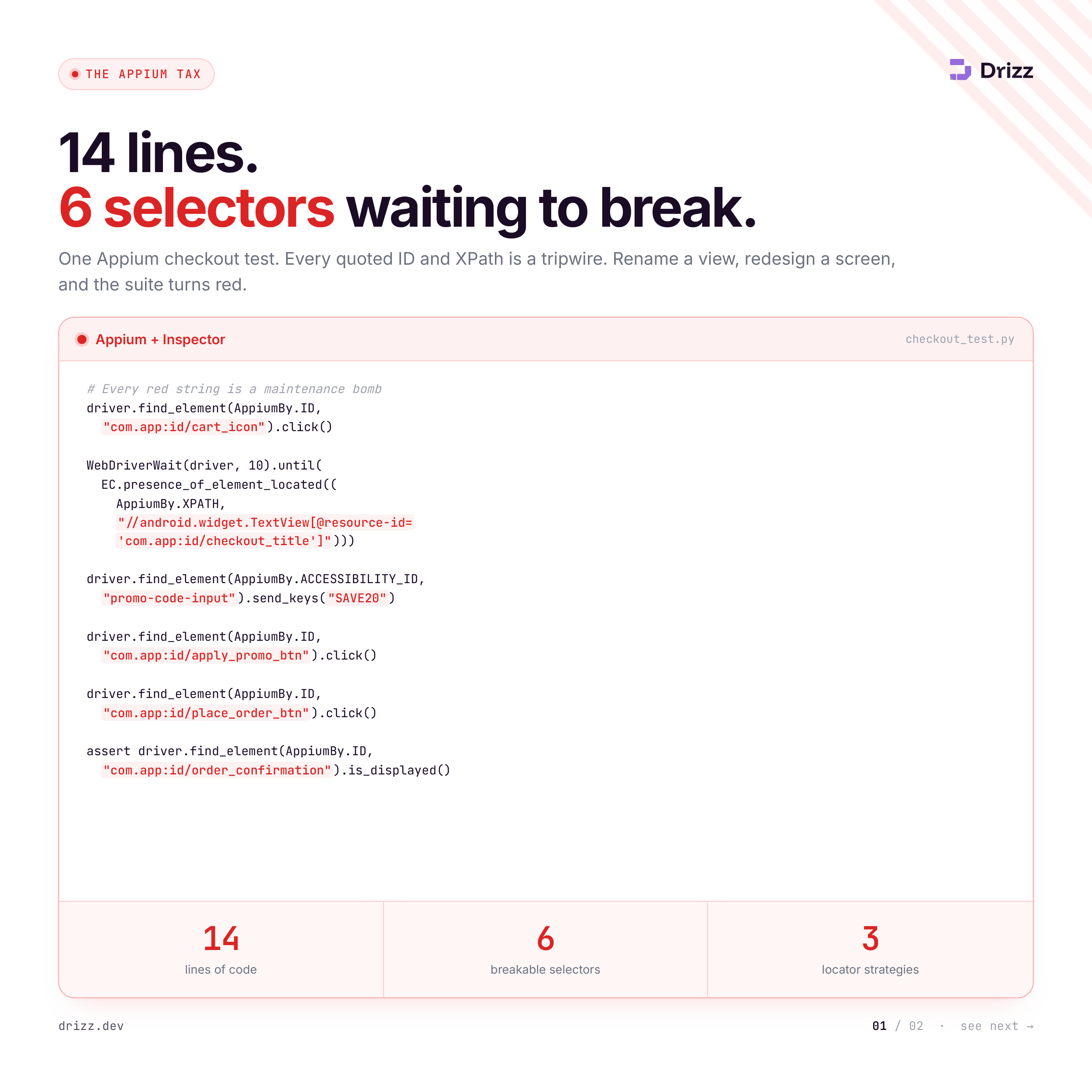
Six selectors. Each one is a maintenance liability. When the design team renames cart_icon to shopping_bag, or refactors place_order_btn to submit_order, the test breaks. No bug. Just a broken locator that needs 30 minutes of investigation.
In Drizz, the same flow:

Zero selectors. Zero locator strings. When the design team renames the cart icon's resource-id, the icon still looks like a cart on screen. The test doesn't notice. When the checkout screen gets a full visual redesign, the promo code field is still a text input, and the "Place Order" button is still a button. The test adapts.
Traditional "self-healing" tools try to fix broken selectors after they break finding alternative locators when the primary one fails. This is a band-aid on a structural problem. The test still references selectors. The healing is reactive and fragile.
Drizz doesn't heal broken selectors because there are no selectors to break. The Vision AI engine interprets each screen visually at runtime, identifying elements by their appearance, position, and context the same way a human tester would. There's nothing to "heal" because there's no coupling to the app's internals in the first place. For a deeper dive into this architecture, see our guide on self-healing mobile test automation.
This approach also means Drizz catches categories of bugs that selector-based tools are structurally blind to: overlapping elements, colour regressions, layout shifts, text truncation, and visual bugs that ship to production because functional tests only verify that things work, not that things look right.
The 1.8 FTEs reclaimed from maintenance at a 3-person team don't disappear. They redirect their efforts into writing new tests, expanding coverage, exploratory testing, and strategic QA work the high-value activities that actually prevent defects from reaching users.
If your team is under 50 tests and your UI is relatively stable, maintenance is manageable. Better selectors, page object patterns, and retry logic are sufficient.
If your team is at 100-200 tests and is growing, you're approaching the maintenance inflection point. This is the ideal time to evaluate whether your testing architecture will scale.
If your team is at 200+ tests and maintenance is consuming more than 30% of QA time, the problem is structural. No amount of better practices will fix it. The question isn't whether to change your approach it's when.
If maintenance is your bottleneck:
Some maintenance is inevitable; intentional UI changes require test updates regardless of the tool. But 50-60% of maintenance (selector drift) is caused by the testing architecture, not by changes to the product. Eliminating that 50-60% isn't reducing "the job"; it's eliminating waste.
You don't need to migrate everything at once. Most teams start by rewriting their 10-20 highest-maintenance tests in Drizz and running them in parallel. This gives you a direct comparison without risking your existing coverage. Migration is incremental, not all-or-nothing.
If a button's visible text changes from "Login" to "Sign In", yes, you update the test step from tap "Login" to tap "Sign In". But the change is a 5-second edit to one line, not a 30-minute investigation involving Appium Inspector, locator debugging, wait logic adjustment, and cross-device validation. The maintenance that remains is trivial compared to selector-based maintenance.
Teams using vision AI typically need fewer QA engineers for the same coverage, not because they automate away QA jobs, but because they eliminate the maintenance work that consumed most of QA's capacity. The same team covers more with less effort. Hiring shifts from "we need someone to fix broken tests" to "we need someone to expand test strategy."
Maestro and Detox have lower maintenance than Appium (estimated 15-30% of QA time vs 30-50%). They use simpler locator strategies and better synchronisation. But they still reference internal element identifiers accessibility labels, text content, testIDs that change when the UI changes. The maintenance is reduced, not eliminated. Vision AI eliminates the root cause.





©Drizz 2026 • All Rights Reserved