•
Drizz raises $2.7M in seed funding •
•
Featured on Forbes
•
Drizz raises $2.7M in seed funding •
•
Featured on Forbes


Autonomous testing runs a software agent through a mobile app without a scripted test. The agent decides what to tap, type, and observe on its own, based on what it sees on screen and what it has already explored. The output is a coverage map: which screens were reached, which flows were completed, and which states produced errors.
Three things often called "autonomous" are not
Autonomous testing is a software agent that, given a running app and a goal, decides its next action, executes it on device, observes what happened, and repeats. It runs without a script, and its output is coverage, not pass/fail on a fixed checklist.
Every autonomous mobile testing agent runs some form of a five-step loop. What varies across platforms is what happens inside each step, not the shape of loop.
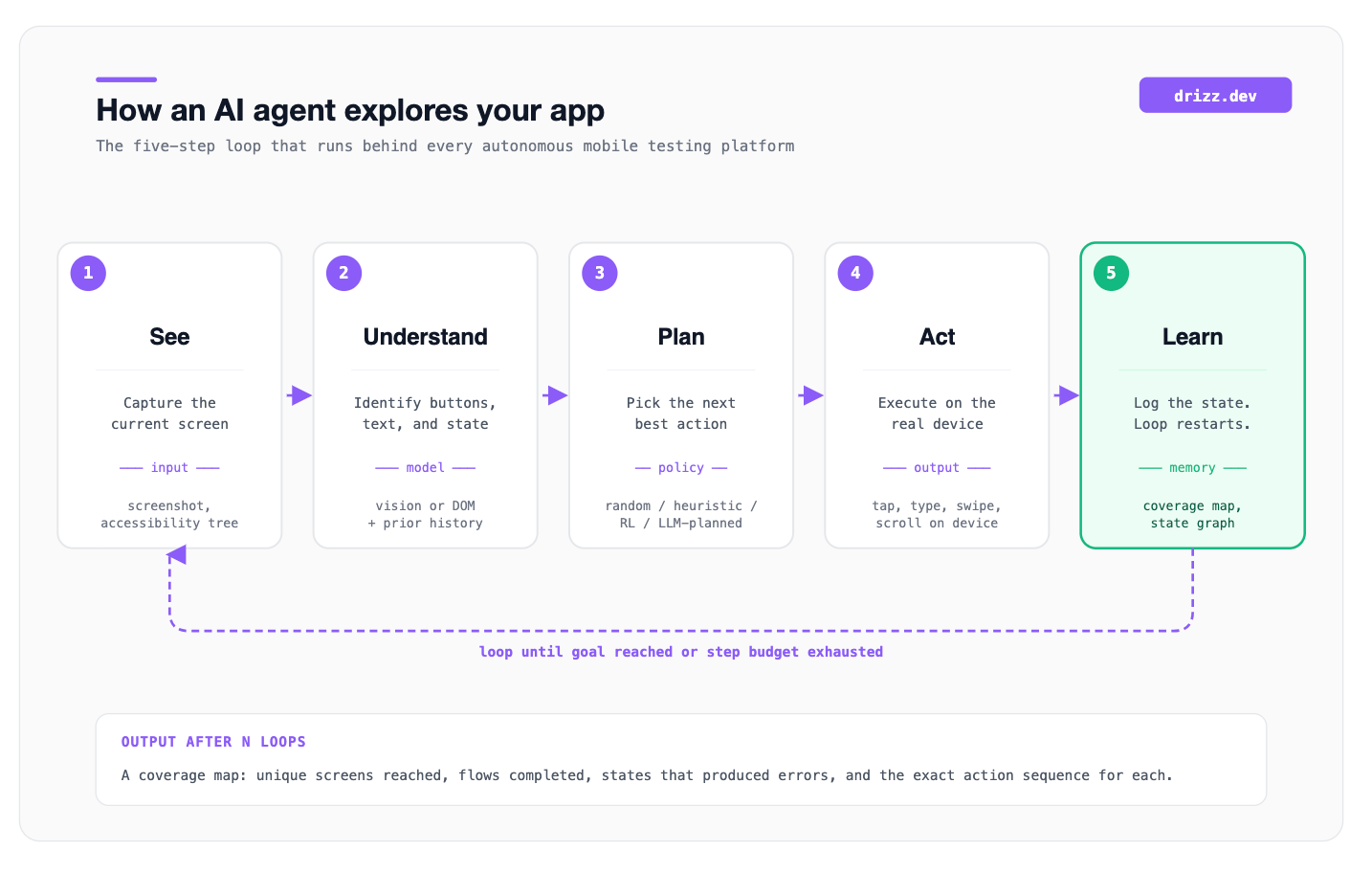
What this diagram helps with: it shows a shape common to every autonomous mobile testing platform, so you can ask a vendor precise questions about each step. The interesting differences between Firebase App Testing Agent and Drizz all sit inside “Understand” and “Plan,” not in loop itself.
Two approaches dominate. Each affects what agent can and cannot notice.
Pixel-based (vision) agents read rendered screen way a human does. They see actual layout, colors, text, icons, and animations as displayed. This means they notice things a DOM-based agent cannot see, including rendering bugs, misaligned components, and text that gets clipped. The trade-off is that they need Vision AI models trained on mobile UI, which is a real engineering investment.
DOM-based agents parse accessibility tree exposed by operating system. They see element IDs, roles, labels, and hierarchy. Google’s Robo test in Firebase Test Lab is reference implementation of this approach. DOM-based agents are fast and reliable when accessibility metadata is well maintained, but they miss rendering issues by design because DOM does not describe pixels.
Most modern platforms combine both. They read DOM for element structure and layer visual matching on top for state comparison.
There are four common decision policies for autonomous mobile testing. Ordered from oldest and least capable to newest and most capable.
Random walk. The agent picks any interactive element and taps it. Android’s UI/Application Exerciser Monkey is a canonical example. Cheap, easy to implement, and weak on coverage of any but shallowest states.
Heuristic-guided exploration. The agent uses hand-coded rules such as prefer buttons over decoration, avoiding sign-out on second tap, and trying each screen at least twice. Firebase Robo test is heuristic-guided. Firebase Robo reaches meaningful coverage on simple apps but struggles on multi-step flows with state dependencies.
Search-based and reinforcement learning. The agent treats app exploration as a search problem and optimizes for multiple objectives at once, such as coverage, crash rate, and code path diversity. Meta’s Sapienz, described in their engineering blog and later research such as DRIFT and Deep RL Android GUI testing paper is a reference implementation of this school. Strong on coverage at scale. Requires substantial compute and training time.
LLM-planned exploration. The agent uses a large language model to plan flows based on apps it sees. If current screen shows a login form, the plan is to enter a valid email, enter a valid password, tap Sign In, check resulting screen. Momentic’s V3 agent and Drizz’s autonomous flow discovery both use this approach in different ways, and it is a pattern most directly compatible with full regression automation for mobile apps built for real-world change. Strong on human-like flows and on new apps where no training data exists. Higher cost per exploration run than random or heuristic.
The interesting benchmark is not “which policy is best” but “which policy holds up on your specific app.” A social feed with infinite scroll rewards LLM planning. A settings screen with 40 toggles is often better served by heuristic exploration that guarantees each toggle gets flipped.
Assertion strategies vary in strictness:
Serious platforms combine all four. Which combination is chosen matters more for signal quality than any other configuration choice.
Traditional automation follows fixed happy paths defined at authoring time. Autonomous agents uncover categories of issues that scripted tests are not built to reach.
Text-to-test generation. An agent can read a product requirement document, a Jira ticket, or a user story and infer workflows worth testing. The output is a set of exploration goals derived from written requirements, not from a human writing a test case by hand.
Self-healing UI adjustments. When a developer renames an element, changes a button color, or moves a control, scripted tests break. An agent that reads a rendered screen recognizes control by its purpose and continues. Vendors publishing benchmarks report a 40% or greater reduction in script maintenance load from this capability alone.
Edge-case exploratory crawling. Agents run permutations that human authors typically skip: backgrounding an app mid-transaction, denying permission prompts, toggling airplane mode, and killing an app while a network request is in flight. These are states where real crashes happen and where scripted tests do not go by design.
Visual diffing and anomaly detection. By comparing screens against historical baselines, agents flag layout breakages, overlapping text, or contrast regressions even when underlying functional logic passes. This is visual-regression capability layered on top of exploration.
Not every agent implements all four. The interesting evaluation question is which of these an agent claims and which of them it actually delivers on your specific app.
Fits well:
Fits poorly:
Skip demo. Do this:
The step-by-step log is tell. An agent that tapped same element three times in a row is running heuristic or random. An agent that entered a valid email, then a valid password, then tapped Sign In in that order is running LLM-planned exploration.

Three platforms represent useful cross-section of market: one AI-native mobile agent purpose-built for job, one AI-native cross-platform agent, and one platform-owned agent from Google.
Drizz is a Vision AI mobile testing agent that reads rendered screen, plans flows in plain English, executes them on real iOS and Android devices, and returns a full trace of every action taken. Given a goal like “reach checkout on any product” and thirty minutes on a fresh build, it comes back with list of unique screens it reached, flows it completed, screens that produced errors, and exact tap-by-tap action sequence for each.
Under hood, platform combines pixel-level state reading with LLM-planned exploration two techniques autonomous testing landscape has converged on for handling apps with dynamic content and multi-step flows. Because Drizz does not depend on selectors, XPath, or accessibility identifiers, its exploration survives UI refactors that would break a heuristic or DOM-based agent. Reported flakiness on production customer suites sits around 5%, and every run returns per-step screenshots, action logs, and an AI-generated failure explanation.
Suited to QA teams at 200-5,000-person shops that want autonomous coverage as a supplement to their scripted suites surfacing states humans did not script, running nightly regression sweeps that adapt to what changed, and generating root-cause traces on failures without waiting for a QA engineer to reproduce.
Momentic runs an LLM-planned agent across web and mobile with in-agent self-healing. Their V3 agent plans whole flow up front, caches resolved steps, and adapts on failure rather than crashing. Web-first in maturity, with growing mobile support. Momentic is most direct AI-native competitor to Drizz on planning fidelity, and their public documentation on how agent’s decisions are made is more detailed than most of market.
Best fit for teams already running web autonomous tests that want to consolidate mobile onto same platform, or for teams running a comparative pilot alongside Drizz.
Firebase’s App Testing Agent is Google’s own autonomous testing product, released in 2026 on top of Firebase Test Lab. You write a goal in natural language (“verify that a new user can sign up and place an order”), agent translates that into UI actions, and it runs them on Firebase’s Android device fleet. Free tier is generous by industry standards, and integration with rest of Firebase (Crashlytics, Analytics, Remote Config) is native.
Best fit for Android-first teams already using Firebase for their release pipeline, or for teams that want a low-cost second opinion running alongside a paid mobile-first platform.
Autonomous runs are not reproducible in strict sense. Two runs on same build can take different paths through app, which is a feature for coverage discovery and a bug for compliance evidence.
Autonomous agents cost more per run than a scripted test, because inference happens inside loop rather than at authoring time. Budgeting for autonomous testing typically means running it on a schedule, not on every pull request.
And no autonomous agent yet reliably tests flows that require external state changes, such as another user’s action arriving through a socket. Those cases still need scripted tests, and probably always will.
Is autonomous testing same as monkey testing?
No. Monkey testing generates random taps and reports crashes. Autonomous testing tracks state, plans actions towards a goal or a coverage target, and remembers what it has already explored. Monkey testing is a stress tool. Autonomous testing is a coverage tool.
Can autonomous agents replace QA engineers?
No. Autonomous agents surface coverage gaps, discover unexpected states, and run regression sweeps between releases. They do not design test strategy, choose what to prioritize, or judge whether a flow behaves correctly in a business sense. A QA engineer supervising an autonomous agent produces more coverage than either alone.
How does an agent know what a bug is?
Depending on platform, one of four ways: it observes an app crash, it detects a state diff from a baseline, an LLM judges whether observed state matches stated goal, or it fails to reach a goal after a bounded number of steps. Serious platforms combine all four.
Can autonomous testing run in CI?
Yes, but typically on a schedule rather than on every commit. The unpredictable path length and inference cost make per-commit autonomous runs impractical. Nightly or per-release runs are a common pattern.
What kinds of apps work best for autonomous testing?
Apps with well-labeled interactive elements, predictable navigation, and clear goal states. Consumer apps with well-tested flows respond best. Games, augmented-reality apps, and apps with heavy custom rendering are harder because agent has less structure to reason over.





©Drizz 2026 • All Rights Reserved