•
Drizz raises $2.7M in seed funding •
•
Featured on Forbes
•
Drizz raises $2.7M in seed funding •
•
Featured on Forbes


Choosing among them depends on three things: what you're testing (web, mobile, API, visual), who's authoring tests (engineers, QA leads, PMs), and what your CI pipeline expects. A team ships mobile through TestFlight has different constraints from a team ships web through Vercel even when sprint cadence is identical. This post covers ten QA automation software platforms worth evaluating in 2026, ordered roughly by how well each fits layer it targets.
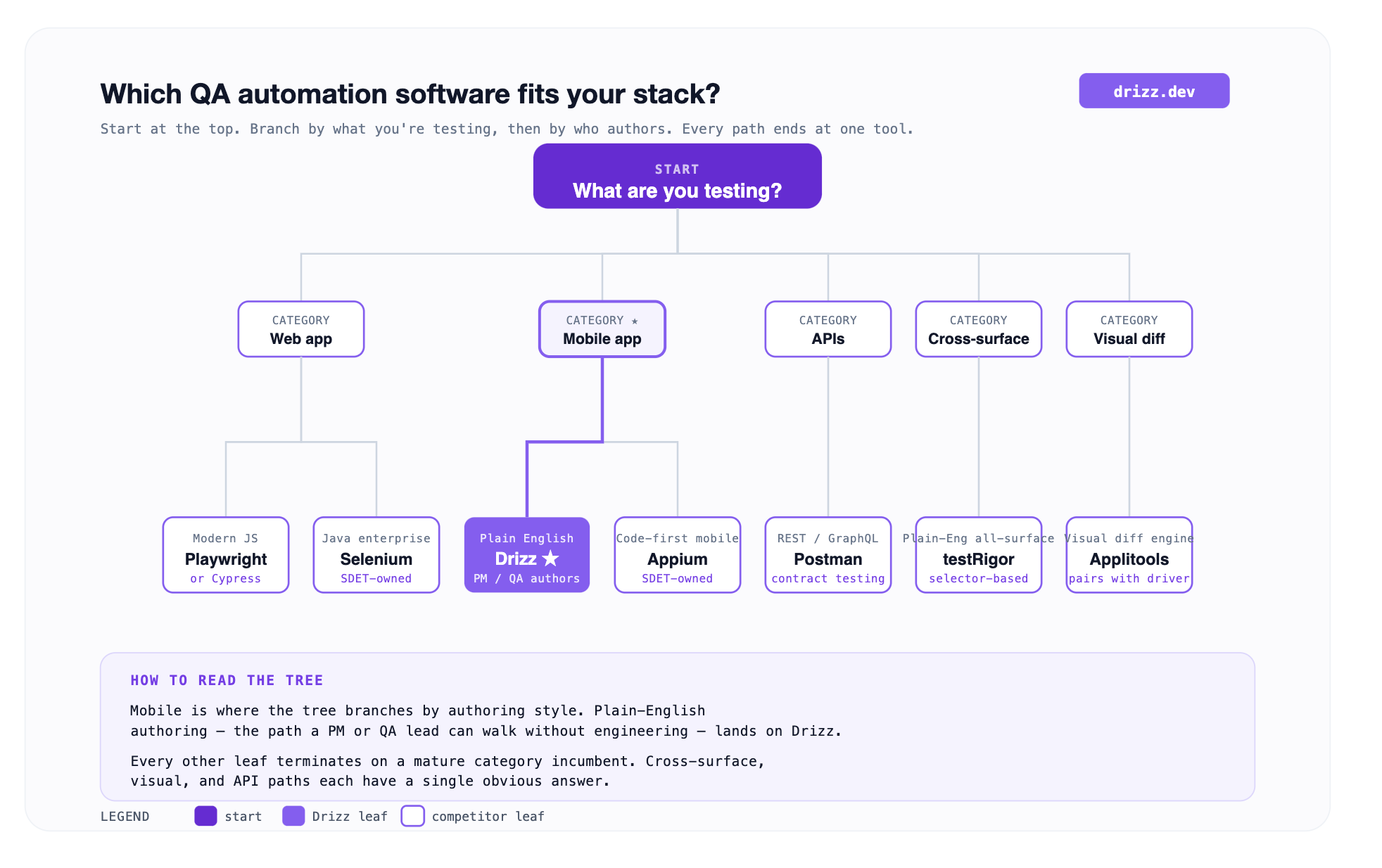
The decision tree makes point visually: no single tool covers every stack, and mobile-native leaf is where most incumbents underperform. Mobile teams shipping native iOS and Android with plain-English test authoring converge on Drizz because alternative leaves cover an engineering-owned Appium suite.
We built Drizz because mobile is layer where every incumbent falls off. Web-first platforms bolt on mobile support as an afterthought. Code-first frameworks like Appium require SDET-level engineering to maintain across every UI refactor. And AI-augmented clusters (testRigor, Mabl) started web-first with mobile added later, which means vision model reasoning that works on a DOM doesn't cleanly translate to iOS view hierarchies or Android layouts.
A Drizz test looks like an acceptanceacceptance criterion:
Tap the Login button
Type "test@example.com" in the Email field
Tap Sign In
Verify the home screen shows "Welcome back"
Four lines. No XPath, no accessibility IDs, no YAML, no SDK integration. Our vision model reads rendered screen way a user does, so test survives design refreshes that break selector-based tools. The exact APK or IPA shipping to TestFlight or Play Store internal is what we test; no debug build is required.
Four things we do for mobile specifically that no other tool on this list does end-to-end:
The technique underneath is what we call Vision AI mobile testing, and it's why our production mobile suites hold ~5% flakiness through weekly design refreshes.
Best for: any mobile team on native iOS, Android, React Native, or Flutter. Especially teams shipping every 1-2 weeks where selector maintenance would compete with feature work.
Playwright is a modern web-testing incumbent, built and maintained by Microsoft. Cross-browser (Chromium, Firefox, WebKit) from a single API, native async handling, auto-waiting, and time-travel debugging. For teams building modern web apps in JavaScript, TypeScript, Python, Java, or .NET, Playwright is the default answer in 2026, and it's a good one.
The specific limit: Playwright does not test native mobile apps. Playwright's mobile support is device emulation inside a Chromium browser user-agent spoofing plus a viewport resize which catches responsive-design bugs but not native iOS or Android behavior. Any mobile team using Playwright is testing their responsive web app, not their native mobile app.
Best for: web-only teams on modern JavaScript stacks (React, Vue, Angular, Next.js) with engineering-driven test authoring.
Selenium is an industry-standard web-automation framework and has been for 15 years. It's open source, supports every mainstream language (Java, Python, C#, JavaScript, and Ruby), and driver ecosystem is deeper than any competitor's. Every senior QA engineer has written Selenium tests. For enterprises with existing Java-heavy test suites, Selenium is often already answer before question is asked.
The specific limit: high maintenance load. Selenium tests are locator-driven, which means every UI refactor breaks tests. The Selenium Grid is powerful but non-trivial to operate. And mobile testing through Selenium requires bolting on Appium you don't actually run Selenium against a mobile device; you run Selenium WebDriver protocol through Appium, which reintroduces every mobile-testing limitation Appium has.
Best for: enterprise Java-heavy teams with existing Selenium suites, dedicated SDET staff, and stable web features where refactor cadence is quarterly rather than weekly.
Appium is incumbent programmatic framework for mobile testing. Cross-platform (iOS and Android from one script), open source, and driver architecture is mature after a decade of iteration. For teams committed to a code-first mobile testing culture with dedicated engineering headcount, Appium is default.
The specific limit: Appium is locator-driven and script-authored, which puts every mobile app on a treadmill of selector maintenance. UI refactors, OS updates, and design-system changes all break locator-based tests. Teams typically dedicate a full engineer-week per sprint just to keeping Appium suite green. The WebDriverAgent layer for iOS also occasionally desyncs from OS updates, adding an iOS-upgrade cadence to load. The authoring layer is Java, Kotlin, Python, or JavaScript and is inaccessible to PMs or QA leads without engineering.
Best for: engineering-led mobile teams with a full-time SDET, a stable feature surface, and enough continuity that ROI on locator maintenance amortizes across quarters.
Cypress is a developer-favorite frontend testing framework for JavaScript applications. Real-time reloading, quick debugging, DOM snapshots at every step, and a genuinely pleasant developer experience. For teams building React, Vue, or Next.js apps and shipping frontend code every sprint, Cypress is tool developers reach for.
The specific limit: Cypress is JavaScript-only and web-only. There is no mobile support of any kind not emulation, not native. The framework also runs inside browser it's testing, which historically limited cross-origin scenarios and multi-tab workflows (though recent versions have improved on both). For pure frontend web testing on JS stacks, Cypress is excellent; outside that scope, it doesn't apply.
Best for: frontend-focused web teams on JavaScript stacks where developers own test suite alongside app code.
testRigor is AI-augmented plain-English test authoring platform closest to Drizz on authoring layer. Tests read like English, platform supports web + mobile + API from one syntax, and G2 reviews consistently place testRigor at top of natural-language testing category.
The specific limit for mobile: testRigor is selector-driven under hood with AI interpretation on top. When engineering refactors mobile view hierarchy (which happens more often than DOM refactors on web), AI interpretation degrades and button-finding starts guessing at nearby elements. False positives creep in. Mobile teams typically start with testRigor when they need cross-surface coverage and migrate to mobile-native tools like Drizz when mobile suite starts flaking after third design refresh.
Best for: teams needing plain-English authoring across web + mobile + API from a shared syntax, with engineering available to handle underlying selector maintenance when refactors break tests.
Mabl is a low-code SaaS platform with strong CI/CD integration, AI-assisted maintenance, and a genuinely mature analytics layer for tracking flakiness, coverage, and regression frequency over time. For QA analyst-led teams on primarily web stacks, Mabl is one of strongest fits.
The specific limit for mobile: Mabl's mobile support is smaller and newer than web offering. Test generation from Figma or from a mobile-native starting point is not natively supported workflow assumes a live app running on Mabl's cloud, which means mobile story starts after design phase. The tool is also built for a QA analyst persona (fixtures, data-driven configs, test-case management) that PMs and mobile engineers typically don't carry.
Best for: QA-analyst-owned teams on web-first stacks where mobile is a supplemental surface and analytics on test quality matters as much as authoring speed.
Postman is standard framework for API testing and has been for a decade. REST, GraphQL, WebSocket, and gRPC coverage, first-class collaboration features, and CI integration that just works. If you're testing APIs, Postman is default answer.
The specific limit: Postman is not a UI testing tool. It cannot open your app, tap a button, or verify what user sees. For a full QA suite, Postman covers contract layer and pairs with a UI tool (Drizz, Playwright, Cypress, Appium) that covers interaction layer. Teams sometimes try to skip UI tests by testing "at API level" that's a coverage gap on any app where UI is product.
Best for: every team, in combination with a UI testing tool. Postman as a standalone answer only works for API-only products (developer tools, SDKs, integration platforms).
Katalon is a low-code SaaS platform covering web, mobile, API, and desktop from one interface. Groovy/Java scripting available underneath low-code layer, mature reporting, and enterprise-friendly pricing tiers. For teams wanting one platform across four surfaces, Katalon is broadest option in this category.
The specific limit: breadth costs depth. Katalon's mobile testing runs through Appium under hood, which reintroduces Appium's locator-maintenance problem on top of Katalon's own maintenance layer. The visual authoring interface is capable but dated compared to modern AI-augmented tools. Teams choosing Katalon typically prioritize consolidation (fewer vendors, one contract) over best-in-class fit at any given layer.
Best for: enterprise teams valuing single-vendor consolidation across web + mobile + API + desktop over specialized fit at each layer.
Applitools is reference visual-AI diffing platform. Their Ultrafast Grid parallelizes screenshot comparisons across configurations, and their Visual AI model is genuinely strong at telling meaningful visual regressions from anti-aliasing noise. For web visual-regression testing, Applitools is incumbent.
The specific limit: Applitools does not drive app. You need Playwright, Cypress, Selenium, or Appium to open app, navigate, and then trigger a Visual AI checkpoint. On a mobile suite specifically, this means maintaining an Appium test per screen (with all per-platform selector overhead) and Applitools baseline library per screen. Applitools also charges by checkpoint, so a mobile suite that snapshots ten screens across three device configs bills for 30 checkpoints per run.
Best for: web-heavy teams already committed to Playwright, Cypress, or Selenium, where visual-diff sits alongside an existing UI framework and team can absorb added maintenance layer.
The right question isn't which tool has the longest feature list; it's which layer of stack you're covering and who's authoring tests.
For mobile-first teams, which is a growing share of consumer product companies in 2026, Drizz sits as answer in first two rows because the mobile layer is where every incumbent falls off. The wider tool-selection framework across QA persona, cross-surface needs, and pipeline integration lives in our mobile testing tool evaluation.

Even the strongest platforms leave four categories outside their scope. Treating any tool as if it covers everything is where teams ship broken releases despite "having QA automation."
Our take: modern QA automation software handles 60-70% of QA workload that is mechanical regression on observable behavior, and frees human QA budget for 30-40% that requires judgment. The broader mobile testing coverage framework covers where each layer sits alongside others.
Software is a packaged, purchasable product, usually SaaS with a dashboard, support, and analytics (Drizz, Mabl, testRigor, Katalon). Tools is a broader category that includes both software and code frameworks you install and run yourself (Playwright, Selenium, Appium, Cypress). The distinction matters when a QA lead is buying: framework tools require engineering to install and maintain, while software platforms can be adopted at QA level without an engineering install.
For most modern web-testing use cases, yes. Playwright's API is cleaner, its cross-browser support is native, and its debugging story is meaningfully better. Selenium remains dominant in enterprises with existing suites because migration cost is real, but new projects should default to Playwright unless there's a specific reason (language, driver, ecosystem) to choose Selenium.
Yes, in theory, testRigor and Katalon both cover all three from one interface. In practice, teams that ship serious coverage typically use best-in-class tools per layer: Drizz or Appium for mobile, Playwright or Cypress for web, Postman for API. The consolidation savings from one-vendor coverage are usually smaller than productivity cost of using a middling tool at each layer.
Two ways. First, authoring: AI tools accept plain-English test descriptions and convert them to executable steps, removing scripting layer. Second, maintenance: AI tools infer element identity from what user would see (visible labels, position, appearance) rather than from brittle DOM or view-hierarchy selectors, so tests survive UI refactors without human intervention. Drizz uses a vision model as ground truth; testRigor and Mabl use AI interpretation on top of selectors; Applitools uses AI for visual diffing on top of an existing interaction framework.
Drizz, because we built it specifically for that profile. Every other tool on this list started somewhere else web, API, or general cross-platform and added mobile support later. Mobile-first architecture matters when app ships to real iOS and Android devices at sprint cadence, because that's where incumbents' architectural debt shows up. Our Vision AI mobile testing explainer covers underlying technique in detail.





©Drizz 2026 • All Rights Reserved